Cape Town Vampire Kingdom
The Secret VampireCape Town Vampire Kingdom is the ruling vampire institution of Cape Town, organized around a king, a queen, royal children, servants, and a wider population of vampires. Its decisive significance lies in its transformation: it begins as the power behind a violent order in which humans cannot safely leave their homes at night, but its future is redirected toward human–vampire coexistence when Callum challenges the old royal policy and succeeds Vlad as Vampire King.
Nature and Royal Structure
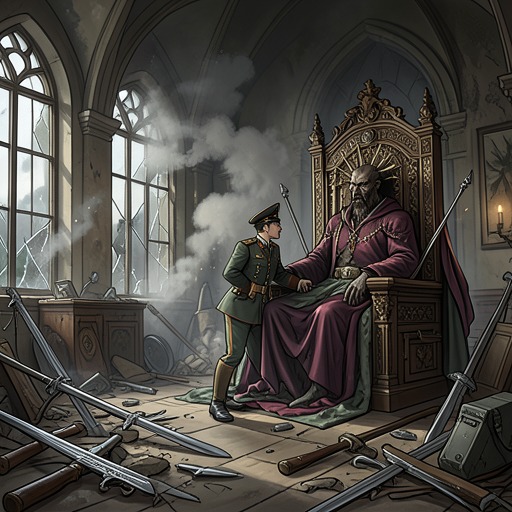
Cape Town Vampire Kingdom is presented as both a political realm and a supernatural society. Ten years before the main events, vampires are numerous throughout Cape Town, while humans live under constant threat of being killed or fed upon. The vampires are ruled by a king and queen, making the kingdom a centralized hereditary authority rather than a loose collection of predators. Vlad occupies the throne as Vampire King, and Carmilla is his crowned wife and queen. Their household includes their daughter Elise and Callum, a young human who is transformed and adopted as their son and legacy.
The kingdom's social order is marked by a sharp boundary between human and vampire identity. Its members possess advantages that make conventional human resistance difficult: they are fast, stealthy, physically powerful, and capable of using supernatural abilities. Their existence is also concealed from ordinary humans. This hierarchy gives the royal family both political authority and practical control, while leaving human communities exposed to the consequences of vampire custom.
War with Human Cape Town
The kingdom's violent relationship with the human population leads to the Human–Vampire War of Cape Town. Human residents become exhausted by their confinement and fear, because the presence of vampires makes nighttime movement and ordinary public life dangerous. The human Mayor of Cape Town therefore declares war against the vampires, a decision that angers Vlad and turns an already unequal social relationship into open conflict.
When the human attack begins, the vampires are prepared. Human assaults repeatedly fail, and the town becomes a bloodbath as the fighting continues and more humans die. The humans then develop weapons suited to vampire vulnerabilities, including garlic bombs and holy water. The vampires initially evade these attacks through speed and stealth, but a giant garlic bomb aimed into the sky, combined with holy water, eventually kills or drives back many vampires. The changing weather, from stormy rain to sunshine, accompanies the humans' sense that victory is approaching and that Vlad may have to accept peace.
The prospective settlement establishes the central question facing the kingdom: whether vampire power will continue to mean unrestricted hunting or will be restrained by a new public rule of no hunting and no biting. The war therefore does more than threaten the royal family. It exposes the unsustainability of a kingdom whose security depends on the terror of another population.
Succession, Kinship, and Internal Conflict
The royal household embodies the kingdom's politics. Vlad and Carmilla define its established order, while Callum occupies an unusual position within it. After the injured young man is brought into the castle, Vlad tells him that he is dead and will become their son and legacy. The boy is named Callum, his eyes change from blue to red, and his transformation places him inside the royal family despite his human origin. This adoption makes the kingdom's idea of blood and belonging more flexible than a purely biological dynasty, even as royal succession remains powerful.
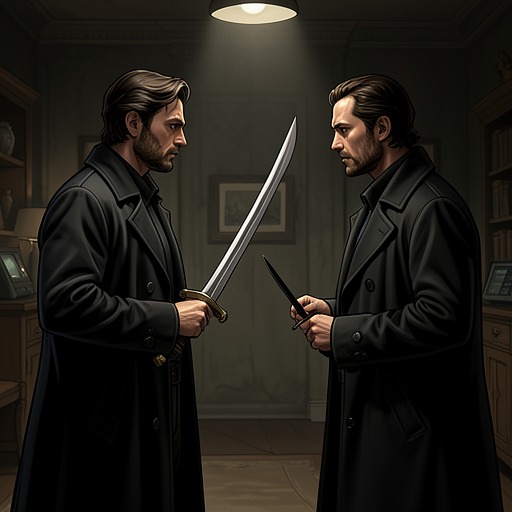
Callum later confronts Vlad directly over the kingdom's treatment of humans. Their dispute becomes a supernatural duel at the castle. Vlad initially gains the advantage, but Callum draws strength from his concern for Celeste and his memories of Susie's suffering, eventually forcing Vlad into a corner. Rather than merely accepting Vlad's verbal promise to stop feeding on humans, Callum produces a written contract and demands the king's signature. Vlad signs the agreement that humans and vampires can coexist peacefully, creating a formal limitation on royal conduct rather than leaving reform to personal goodwill.
The conflict also reveals the emotional cost of the kingdom's old order. Carmilla loves Callum and Elise equally, even though Callum was once human, and her acceptance of him shows that royal kinship can resist species-based exclusion inside the family. Yet Carmilla's death destabilizes the institution. Samara exploits Vlad's grief and uses a potion to take Carmilla's form, manipulating him into believing that he must avenge his wife by killing Celeste. The kingdom's authority is consequently shown to be vulnerable not only to war but also to deception within its own intimate and supernatural networks.
Crisis of Rule and Restoration
After Carmilla's murder, Vlad prepares her funeral while Elise mourns and Callum promises to avenge his mother. Samara then attempts to convert the kingdom's grief into a route to power. Disguised as Carmilla, she traps Vlad with a silver chain, uses the pain caused by silver to control the encounter, and reinforces the command that he should kill Celeste. In the kingdom's terms, magic, royal emotion, and coercion become overlapping instruments of political capture.
The crisis is eventually exposed through Celeste's supernatural gift. At the castle, she creates a portal that reveals the past, and Samara's crime is brought into the open. Samara confesses that she killed Carmilla and Celeste's mother because she wanted greater power and wished to become the most powerful witch in the world. She also admits manipulating Damien's feelings by pretending to be Hannah in order to divide Celeste and Callum. The exposure distinguishes legitimate royal grief from manufactured obedience and allows Vlad to recover his judgment.
Celeste then traps Samara inside a magical hourglass. Vlad carries the hourglass to the dungeons and places Samara in a cell, declaring that the dungeon will be her eternal home after the days she kept Celeste captive. This punishment restores the kingdom's immediate security, but it also shows that the new order still relies on royal imprisonment and supernatural enforcement. Reform does not abolish power; it changes the purpose for which that power is used.
Peaceful Coexistence and Continuing Legacy
The peace agreement signed by Vlad becomes the kingdom's institutional turning point. Its importance is confirmed when Callum takes over from Vlad as Vampire King. The succession places a former human, adopted into the royal family and committed to coexistence, at the head of the vampire realm. The kingdom therefore survives the war and the succession crisis without disappearing, but its political meaning changes from domination over humans toward a more regulated relationship with them.
The later family arrangement gives this change a domestic and generational form. Callum and Celeste marry and have a son, Silas, while Susie and Darren marry and have a daughter, Alessia. Celeste describes the two shining stars in the sky as the grandmothers watching over the children, linking the kingdom's future to memories of both human and vampire loss. In the final family gathering, Callum promises to remain beside Celeste and Silas, while Vlad appears with Elise as the family preserves the moment in a group photograph. The Cape Town Vampire Kingdom thus ends not as an isolated castle ruled by fear, but as a continuing royal community whose survival depends on inherited relationships, restrained violence, and the possibility of human–vampire coexistence.